Your ad gets clicks. Your budget drains. And the people who land on your page read for a few seconds, then leave without doing anything.
At Ovitech, we review ad accounts where the ads themselves are fine, and the real leak is the page behind them. A weak page makes every click cost more, because you pay for the visitor and get nothing back. Landing page optimization often does more for results than rewriting the ad.
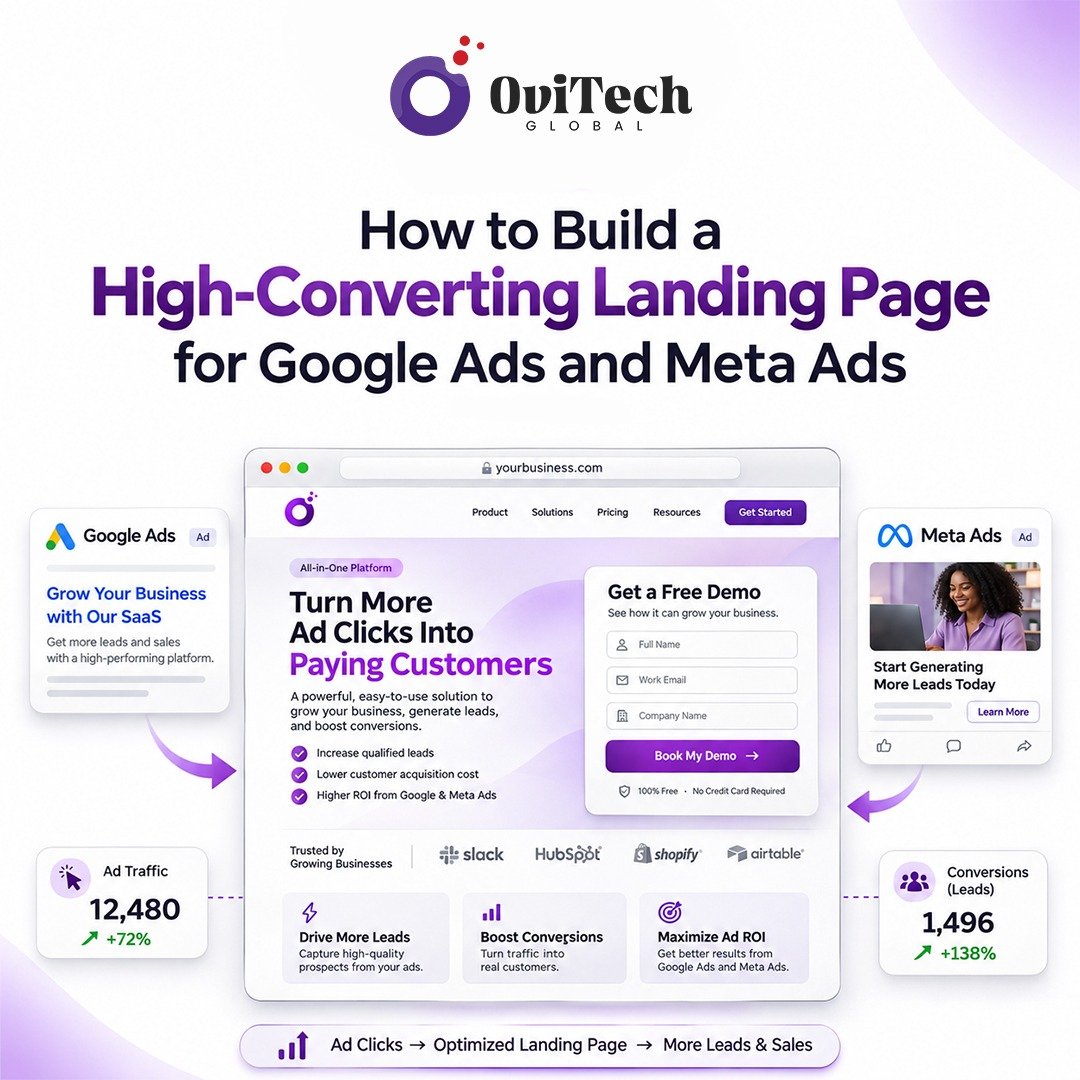
This guide shows how to build a high-converting landing page step by step, with notes on what differs between Google and Meta traffic.
What Is a High-Converting Landing Page?
A high-converting landing page is a standalone page built for one goal, such as a purchase, a call, or a form submission, that turns a large share of visitors into leads or customers. It matches the ad that sent them, removes distractions, and makes the next step obvious.
In short, a landing page is not your homepage. A homepage serves many goals and many visitors. A landing page serves one goal for one audience.
Conversion rates vary a lot by industry, offer, and traffic source, so compare yourself against your own past results first. Many pages land between two and ten percent, and strong ones can go higher.
Why the Page Matters as Much as the Ad
Ad platforms care about the page, too. In Google Ads, landing page experience is one part of Quality Score, alongside expected click-through rate and ad relevance. A relevant, fast, useful page can lower your cost per click and improve your ad position. Meta also rewards ads that people respond to, and a poor page after the click wastes the attention your ad earned.
Think of it as a relay race. A great ad that hands off to a weak page still loses.
Google Ads Landing Page vs Facebook Ads Landing Page
The two platforms bring different visitors, so the same page rarely works equally well on both. Search visitors asked for something. Social visitors were interrupted while scrolling.
| Factor | Google Ads (Search) | Meta Ads (Facebook and Instagram) |
|---|---|---|
| Visitor mindset | Actively looking for a solution | Scrolling, not yet looking |
| Intent level | High | Low to medium |
| What the page must do | Confirm they found the right answer fast | Spark interest and explain the offer |
| Best content style | Direct, specific, proof early | Visual, story-led, clear benefit |
| Typical device | Mixed desktop and mobile | Mostly mobile |
| Message match source | The search keyword and ad text | The ad image, hook, and offer |
| Form length | Can be slightly longer | Keep very short |
| Page length | Often short | Can be longer to build interest |
A Google Ads landing page can get straight to the point. A Facebook Ads landing page, which also serves Instagram placements, usually needs a bit more persuasion because the visitor was not searching.
How to Build a High-Converting Landing Page: 10 Elements
1. Match the Message Exactly
If your ad says "Same day AC repair in Dubai," your headline should say the same thing. A mismatch makes visitors wonder if they clicked the wrong link. Echo the wording, offer, price, and imagery from the ad.
2. Write a Clear Headline and Subheadline
The headline states the benefit. The subheadline adds who it is for or how it works. Skip clever slogans. "Get a free roof inspection this week" beats "Raising the standard."
3. Keep One Goal and One Main Button
Every extra link or option competes with your main action. Remove the top menu, footer links, and unrelated offers. Use one call to action, repeated at natural points.
4. Use a Specific Call to Action
"Get my free quote" works better than "Submit." Say what happens next and what the visitor gets. Clear layouts and button placement come from good UI UX design, and small tweaks here can move numbers quickly.
5. Put Proof Near the Decision Point
Show reviews, client logos, ratings, certifications, and results close to the button. Real names and photos carry more weight than anonymous quotes.
6. Keep the Form Short
Every extra field lowers completion. Ask for name, email or phone, and one short question. You can collect more details on the follow-up call.
7. Make It Fast and Mobile-Friendly
Most social traffic arrives on phones, and slow pages lose visitors before they read a word. Compress images, remove heavy scripts, and test the page on a real phone using mobile data. A free SEO audit can flag speed issues.
8. Show the Offer Clearly
Explain what the visitor gets, what it costs or whether it is free, and what happens after they click. Remove guesswork.
9. Use Visuals That Help
Real photos of your product, team, or work beat generic stock images. A short video can help for Meta traffic, but keep it light so the page still loads quickly.
10. Answer Objections
Add a short FAQ for the questions that stop people from acting, such as price, timing, or guarantees. This helps conversion and also gives search engines and AI tools clean answers to quote.
Landing Page Conversion Best Practices for Each Platform
These landing page conversion best practices help you adapt the page to where the traffic comes from.
For Google Ads
- Build a separate page for each service or keyword group.
- Put your main keyword in the headline.
- Show price ranges, locations, or availability early.
- Make phone numbers tappable and add call tracking.
- Keep content tight, since searchers want answers fast.
Pairing the right page with the right keywords is a core part of good search engine marketing.
For Meta Ads
- Mirror the ad's image and hook in the page's top section.
- Lead with the benefit, then explain how it works.
- Use short sections and large, thumb-friendly buttons.
- Add social proof early, since cold visitors need reassurance.
- Keep forms very short, ideally name plus one contact method.
Strong creative and a matching page work together in social media marketing campaigns.
Set Up Tracking Before You Spend
You cannot improve what you cannot see. Before launching, set up:
- A conversion event for form submissions, calls, and purchases
- Google Ads conversion tracking and the Meta Pixel on the thank-you page
- Tagged links so you can see which campaign sent each lead. A free UTM builder keeps tags consistent.
Without tracking, you will judge pages by guesses.
Real World Example: One Page, Two Platforms
A cleaning company came to Ovitech running the same page for both Google and Meta ads. Google leads were decent, but Meta leads were poor and expensive.
We split the page in two. The Google version opened with the service, price range, and a phone number. The Meta version opened with a before-and-after photo, a short benefit headline, and a three-field form. Both used reviews near the button. Within a few weeks, Meta cost per lead dropped, and the quality of leads improved. (This example is illustrative and not a documented client case.)
The offer did not change. The page now matched the mindset of each visitor.
How to Test and Improve Your Page
Landing page optimization is a loop, not a one-time job. Follow this order:
- Collect enough visitors to judge, at least a few hundred.
- Change one element at a time, starting with the headline.
- Test the form length and button wording next.
- Compare results over a fair period, usually two weeks or more.
- Keep the winner and test the next idea.
Heatmaps and session recordings show where people stop reading or tapping. Once leads arrive, fast follow-up matters, and marketing automation can send instant replies so no inquiry goes cold.
Common Mistakes to Avoid
Sending ad traffic to the homepage. It has too many choices and no clear match.
Using one page for every campaign. Different offers and audiences need different pages.
Hiding the price or offer. Visitors leave when they cannot tell what they are getting.
Overloading the page. More text and options rarely mean more leads.
Not testing on mobile. A broken form on a phone quietly wastes budget.
FAQs About High-Converting Landing Pages
Q1: What is a good conversion rate for a landing page?
It depends on your industry, offer, and traffic source. Many pages convert between two and ten percent. Compare against your own past results and aim for steady gains.
Q2: Should I use my homepage for ads?
Usually not. A homepage serves many goals, while a landing page serves one. Matching the ad with a focused page tends to lower cost per lead.
Q3: How long should a landing page be?
As long as it takes to answer the visitor's questions. Simple, low-cost offers need short pages. Higher-priced or less familiar offers often need more detail and proof.
Q4: Should I remove the navigation menu?
For most ad landing pages, yes. Fewer exits mean more focus on the main action. Keep a logo and any legal links your business requires.
Q5: Do landing pages affect Google Ads costs?
Yes. Landing page experience is part of Quality Score, which can influence your cost per click and ad position. Relevant, fast, useful pages tend to help.
Q6: How many landing pages do I need?
One for each distinct offer, service, or audience you advertise. Many small, focused pages usually beat one general page.
Q7: How long should I test before changing my page?
Wait until you have enough visitors to see a pattern, often a few hundred, and run each test for at least two weeks. Changing too early leads to false conclusions.
Written for business owners and marketers who want ad budgets to turn into leads. More guides live on our blog.